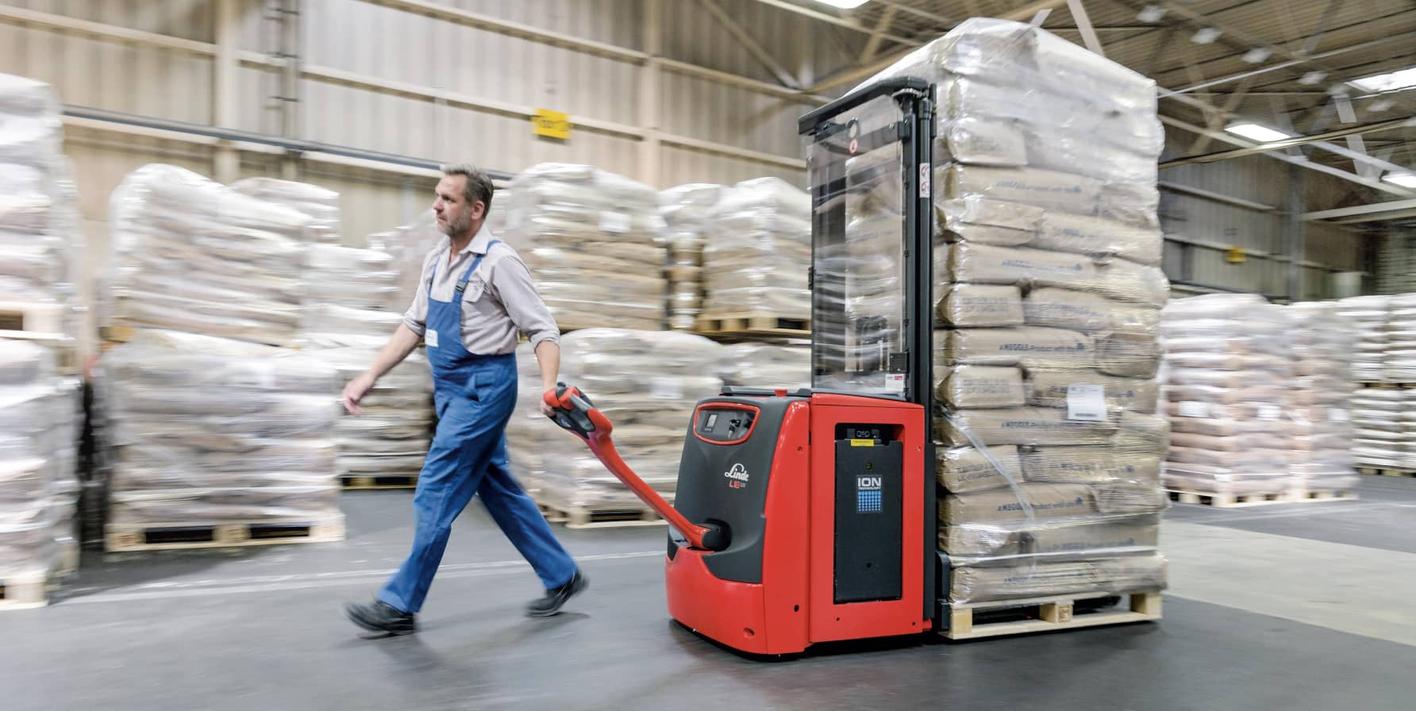
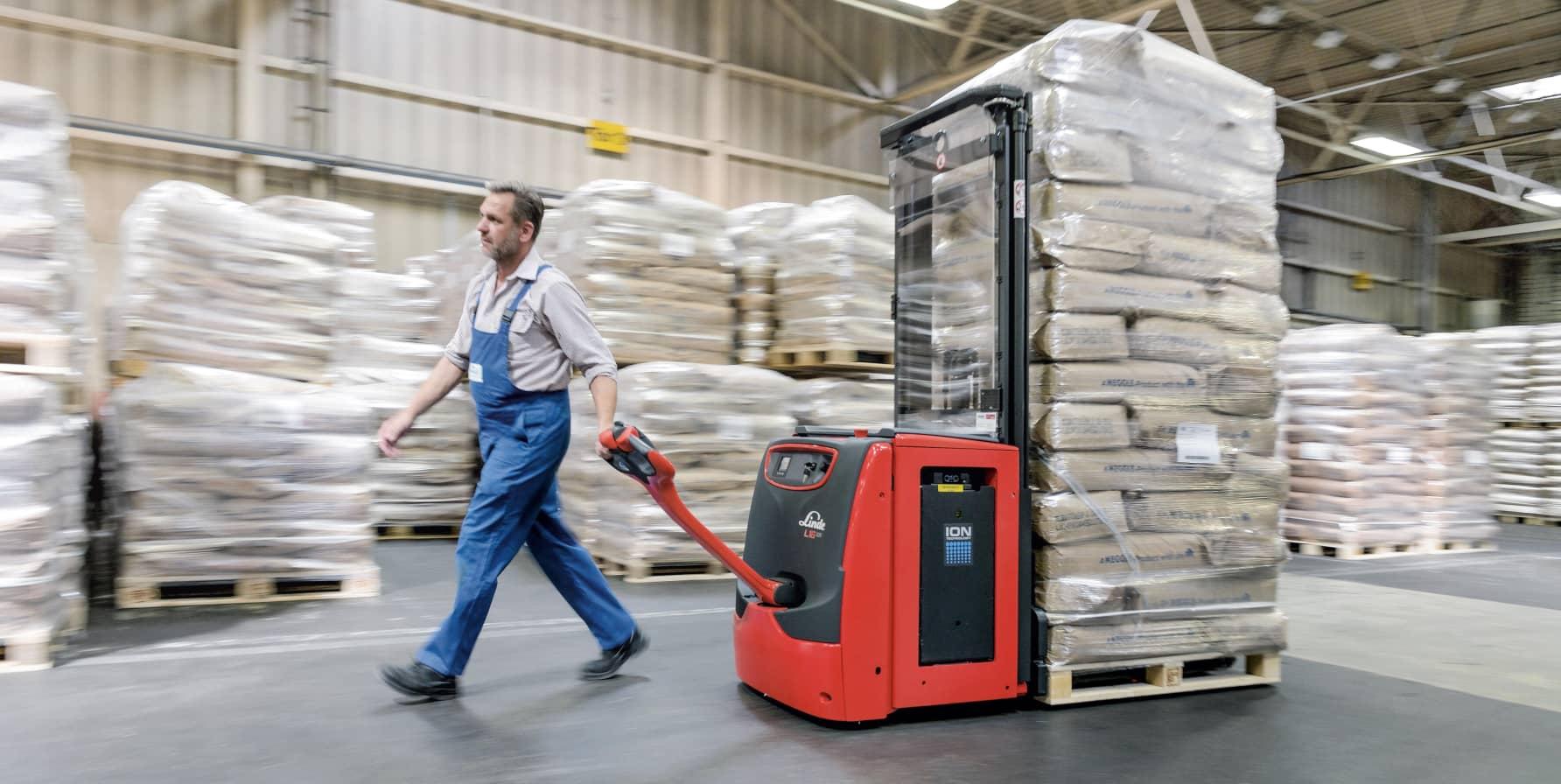
Pallet Stackers
Efficient, agile, powerful and low maintenance
The Power to Choose range consisting of Linde and Baoli electric pallet stackers represents agile, powerful, low maintenance trucks that enable efficient load handling over short and long distances.
They accelerate smoothly with precision and without jerking, and the ergonomic tiller head enables efficient and fatigue-free working, as operators can reach all elements easily and operate the truck intuitively. Capacities range from 0.6 - 2.0 tonnes.
0.6 - 2.0 tonne lifting capacity
Available for hire and purchase

Series 1160
D06 - D08 Electric Pallet Stacker
- 0.6-0.8 tonnes lift capacity
- Electric

Series 1163
D10 Electric Pallet Stacker
- 1.0 tonne lift capacity
- Electric

Series 4596
L10-L12 B AS Electric Pallet Stacker
- 1.0-1.2 tonnes lift capacity
- Electric

Series 1164
D12 S/SF Electric Pallet Stacker
- 1.2 tonne lift capacity
- Electric

Series 1164
D12 R/RW Electric Pallet Stacker
- 1.2 tonne lift capacity
- Electric

Series 1171
L06 - L16 AC Electric Pallet Stacker
- 0.6-1.6 tonnes lift capacity
- Electric

Series 4596
L10-L16 B Electric Pallet Stacker
- 1.0-1.6 tonnes lift capacity
- Electric

Series 1177
L14 - L16 SP Electric Pallet Stacker
- 1.4-1.6 tonnes lift capacity
- Electric

Series 1174
L14 - L16 R/Ri (RW) Electric Pallet Stacker
- 1.4-1.6 tonnes lift capacity
- Electric

Series 1173
L14 - L16 AS/AP Electric Pallet Stacker
- 1.4-1.6 tonnes lift capacity
- Electric
Displaying 10 of 15
Walkie Stacker
Compact, battery-powered walkie stackers built to lift, move and stack pallets safely in warehouses and tight workspaces. Designed for efficient pallet handling, pallet stackers provide a cost-effective solution for transport, shelving and low to medium stacking applications.
View RangeHigh-Performance Walkie Stackers for Efficient Warehouse Operations
When pallet jacks can't provide the lift you need, and a full sized forklift is too large for the space, a walkie stacker fills the gap. These pallet stackers are pedestrian-operated and battery-powered, which means zero exhaust emissions and none of the noise that comes with an internal combustion engine. They're suited to enclosed warehouses, cold stores and retail backrooms, where air quality and noise matter.
The real advantage of an electric stacker is its footprint. Where a counterbalance forklift needs several metres of aisle width to turn, a walkie stacker can work in a fraction of that space. That makes it the practical choice for businesses handling everyday pallet movements where a forklift isn't practical.
Other benefits include:
- Compact chassis designed for narrow aisles and confined warehouse layouts
- Tiller-operated controls that are intuitive for new operators and comfortable across long shifts
- Precise, controlled lifting and lowering that protects both the load and the racking
- Reduced manual handling, which means fewer strains and less fatigue for your team
- Lower running costs than a forklift, with no fuel needed
Across the Linde range, capacities run from 0.6 to 2.0 tonnes. This covers most everyday warehouse loads without the size or cost of a forklift. An electric pallet stacker won't replace a forklift for heavy or outdoor work but for indoor pallet handling, it's often the more sensible, more affordable option.
Ready to find a pallet stacker for sale, or explore flexible walkie stacker hire options for your business? Speak to a Linde Specialist, or call Linde Australia on 1300 454 633.

Explore Our Range of Walkie Stackers
Linde's range of electric pallet stackers covers everything from light-duty models for occasional stacking through to heavy-duty trucks built for multi-shift warehouse work. Lift heights and load capacities vary across the range, so there's a walkie stacker suited to most warehouse layouts and daily volumes.
Every model in the range is designed around reliable lifting performance and operator safety. Whether you want to buy walkie stacker equipment for long term use, or prefer hiring for greater stability, we can help you choose the right solution.
How to Choose the Right Walkie Stacker for Your Business
Picking the right walkie stacker comes down to how it'll actually be used, not just the spec sheet. Before you buy a pallet stacker or commit to a hire agreement, work through these questions:
- Load capacity: What's the heaviest pallet you'll realistically be lifting on a normal day?
- Maximum lift height: How high does the stacker need to reach into your racking?
- Aisle width and available space: How much room do you have to manoeuvre in?
- Daily operating hours: Will the battery need to last a single shift or several?
- Single or double pallet handling: Are you moving one pallet at a time, or does the job call for a double stacker?
- Indoor operating conditions: Are there cold store or temperature requirements to plan for?
- Frequency of use: Is this an everyday tool or an occasional one?
- Total cost of ownership: Servicing, battery replacement and downtime all add up over time. What amount are you comfortable paying to keep this machine going?
- Buy or hire: Which arrangement suits your budget and how long do you expect to need the equipment?
Talk to us, so we can help you hire or buy walkie stacker equipment for your business.
Where are Walkie Stackers Used?
A walkie stacker or pallet stacker earns its keep across a wide range of industries, helping businesses make better use of storage space and keeping pallets moving without tying up a forklift.
- Pallet storage
- Stock replenishment
- Order picking support
- Moving raw materials
- Production line supply
- Finished goods handling
- Back-of-store inventory movement
- Stockroom pallet handling
- Shelf replenishment
- Safe pallet transport
- Warehouse storage
- Cold room operations
- Efficient pallet stacking
- Loading preparation
- Inventory management
Why Choose Linde Material Handling Walkie Stackers?
There's no shortage of pallet stackers on the market, but a few things set Linde machines apart from the rest:
- German engineering: Precision-built trucks designed for reliability under daily use
- Advanced safety features: Including automatic braking, folding side guards and a low chassis skirt that protects the operator's feet
- Ergonomic operator controls: Including an asymmetric tiller head designed to keep a clear sightline to the forks and reduce fatigue over long shifts
- Energy-efficient electric drive systems: With Lithium-ION battery options available across the range for faster charging and no watering or maintenance
- Durable construction: That holds up in demanding, high-throughput environments, including cold store variants rated to -35°C
- Nationwide service and maintenance support: So help isn't far away wherever you're based
- Flexible finance and hire options: To suit different budgets and timeframes
- Expert product advice: Both before you buy and after your equipment is on the floor
Ready to buy pallet stacker equipment or discuss walkie stacker hire? Talk to our team about which walkie stacker suits your operation. Request a quote today.
FAQs
A pallet stacker is a compact, electric-powered warehouse truck designed to lift, stack, and move palletised loads at low-to-medium heights. Unlike a forklift, a pallet stacker is typically used for indoor operations in confined spaces, with load capacities generally ranging from 0.6 to 2.0 tonnes. They come in pedestrian (walkie stacker), stand-on, and sit-on configurations to suit different distances and operational intensities.
A pallet jack (or pallet truck) is designed purely for moving pallets at ground level, i.e. it lifts just enough to clear the floor. A pallet stacker can lift loads to height for stacking on racking or shelving. Linde offers both: pallet stackers for stacking applications, and pallet trucks for ground-level transport.
Linde offers a range of electric pallet stacker models with different load capacities and lift heights, from compact units for light-duty stacking through to heavier-duty trucks for multi-shift operations. Speak with our team to see the current range and find the model that fits your warehouse.
Pricing depends on the model, lift height, capacity and any optional features you need. Because every warehouse is different, we recommend requesting a quote so we can price a stacker against your actual requirements rather than a generic listing.
You can request a quote through our team, who will confirm specifications, pricing and availability based on your operation. This also gives you the chance to check that the model suits your aisle widths and load requirements before you commit.
Yes. Walkie stackers are one of the most common pieces of equipment in Australian warehouses, used for everyday pallet handling, stock replenishment and order picking in spaces where a forklift is unsuitable.
Yes, Linde offers finance solutions structured around your business's cash flow, so you can spread the cost of new equipment rather than paying the full amount upfront.
Warranty terms vary by model, so it's best to confirm the specifics with our team when you request a quote. All Linde equipment is backed by our nationwide service and support network.
Start with your load capacity, lift height and aisle width, then factor in how often the stacker will be used and whether you need single or double pallet handling. Our team can talk you through the options based on your operation.
A walkie stacker is a pedestrian-operated, battery-powered pallet stacker used to lift, transport and stack pallets in warehouses, retail stockrooms, manufacturing sites and distribution centres.
A walkie stacker is pedestrian-operated, more compact, and generally suited to lower lift heights and lighter loads than a forklift. Forklifts are ride-on machines with greater capacity, higher lift heights and the ability to work outdoors, but they need considerably more space to operate.
They're used for everyday pallet handling tasks such as stacking goods on racking, moving stock around a warehouse, replenishing shelves and supporting order picking.
Load capacity varies by model. Across the Linde range, walkie stackers handle loads from around 0.6 tonnes up to 2.0 tonnes, so lighter-duty models suit occasional stacking while heavier-duty trucks are built for larger, more frequent pallet loads. Our team can match capacity to your typical load weight.
Yes. Their compact footprint makes them a practical fit for smaller warehouses, retail stockrooms and other spaces where a forklift would struggle to manoeuvre.
Yes, this is one of their biggest advantages. Some Linde models have chassis widths as narrow as 720mm, built to work in aisles that are too tight for a counterbalance forklift, which is why walkie stackers are common in space-constrained warehouses.
A walkie stacker reduces the physical strain of manual lifting, speeds up pallet movement, and improves precision when placing loads on racking, all of which lowers the risk of workplace injury.
Some models are built for higher lift heights than others, so it depends on the specific truck. If you need to reach higher racking, our team can point you to a model with the lift height to match.
A pallet stacker is the general term for equipment designed to lift and stack palletised loads, it can be walk-behind, ride-on, or even fully powered/reach versions.
A walkie stacker is one specific type of pallet stacker where the operator walks alongside and steers it rather than riding on board, so it's a subcategory rather than a separate thing entirely.
Linde pallet stackers cover 0.6 to 2.0 tonnes. If your loads are consistently under 1.0t, the D06–D10 or L10–L12 range will suit most applications. For 1.4–2.0t loads in regular use, the L14–L20 range offers the capacity and durability for more intensive work. If you regularly exceed 2.0 tonnes, a reach truck or electric counterbalance forklift may be more appropriate. To get help in understanding exactly what you need, talk to a Linde specialist.
Yes. Linde offers cold store variants of several pallet stacker models, engineered to operate reliably at temperatures as low as -35°C. These variants maintain full battery performance and mechanical availability in freezer and refrigeration environments, making them a trusted choice for food, beverage, pharmaceutical, and cold chain operations.
Yes. Linde pallet stackers are available with Lithium-ION battery technology across a number of models. Li-ION batteries charge faster, last longer per cycle, require no watering or battery changes, and can be opportunity-charged during breaks without affecting battery health. This makes them particularly well suited to multi-shift operations. Learn more about Linde's energy solutions.
Yes. Linde pallet stackers are available for short and long-term hire across Australia. The hire fleet includes pedestrian and ride-on models to suit different applications, all factory-maintained to the same standard as new equipment.
Yes, this is one of their key advantages over counterbalance forklifts. Linde pallet stacker models like the L-series and D-series are designed for use in confined warehouse environments. Some models feature chassis widths as narrow as 720mm, electric power steering for tight manoeuvring, and straddle arm configurations for closed pallet handling. For very narrow aisle (VNA) storage applications at height, Linde's VNA turret trucks may be more appropriate.
Licensing requirements for pallet stackers vary by state and by whether the stacker is a pedestrian or rider-operated model. Pedestrian, also known as walkie stackers, generally don't require a forklift licence, but operators still need appropriate training and employer sign-off on competency. Ride-on (stand-on or sit-on) pallet stackers may require a forklift High Risk Work Licence in some states. Always check with your state's WorkSafe or SafeWork authority for current requirements, and consult your Linde specialist for guidance. Find your nearest Linde branch.
A straddle stacker uses extending load arms (legs) that straddle the pallet, providing stability without needing the counterbalance weight of a standard forklift. It requires the pallet to have enough clearance underneath for the arms to fit. A counterbalanced stacker (like the Linde L06–L16 AC) doesn't use load arms, it uses a counterweight at the rear to balance the load, allowing it to handle closed or flush-based pallets that straddle arms can't access.
Linde MH operates a national branch and dealer network with 24/7 service support across Australia. Scheduled maintenance is completed by fully qualified Linde technicians, and genuine parts can be delivered anywhere in the country, with same-day availability in metropolitan areas. Find your nearest service centre.