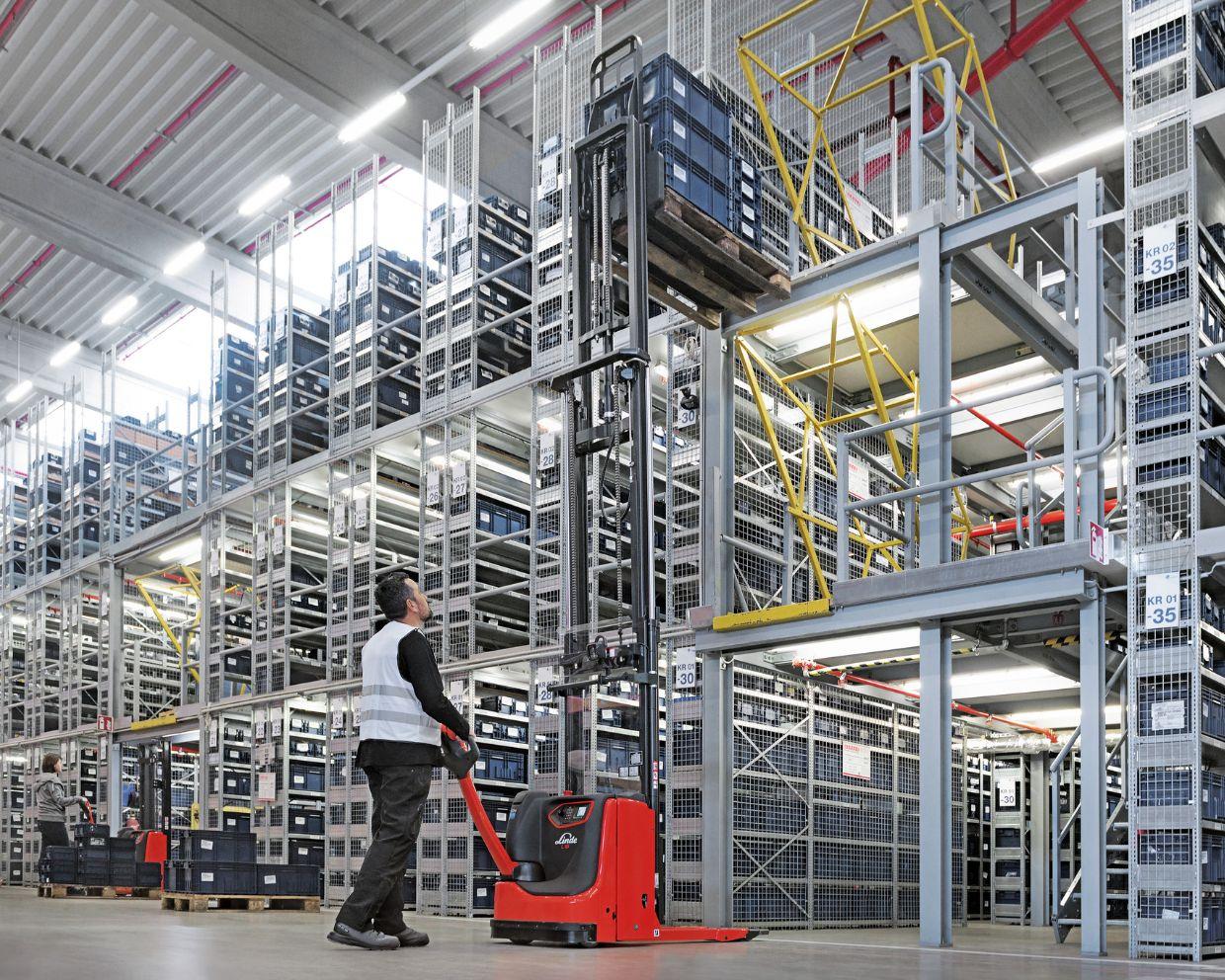
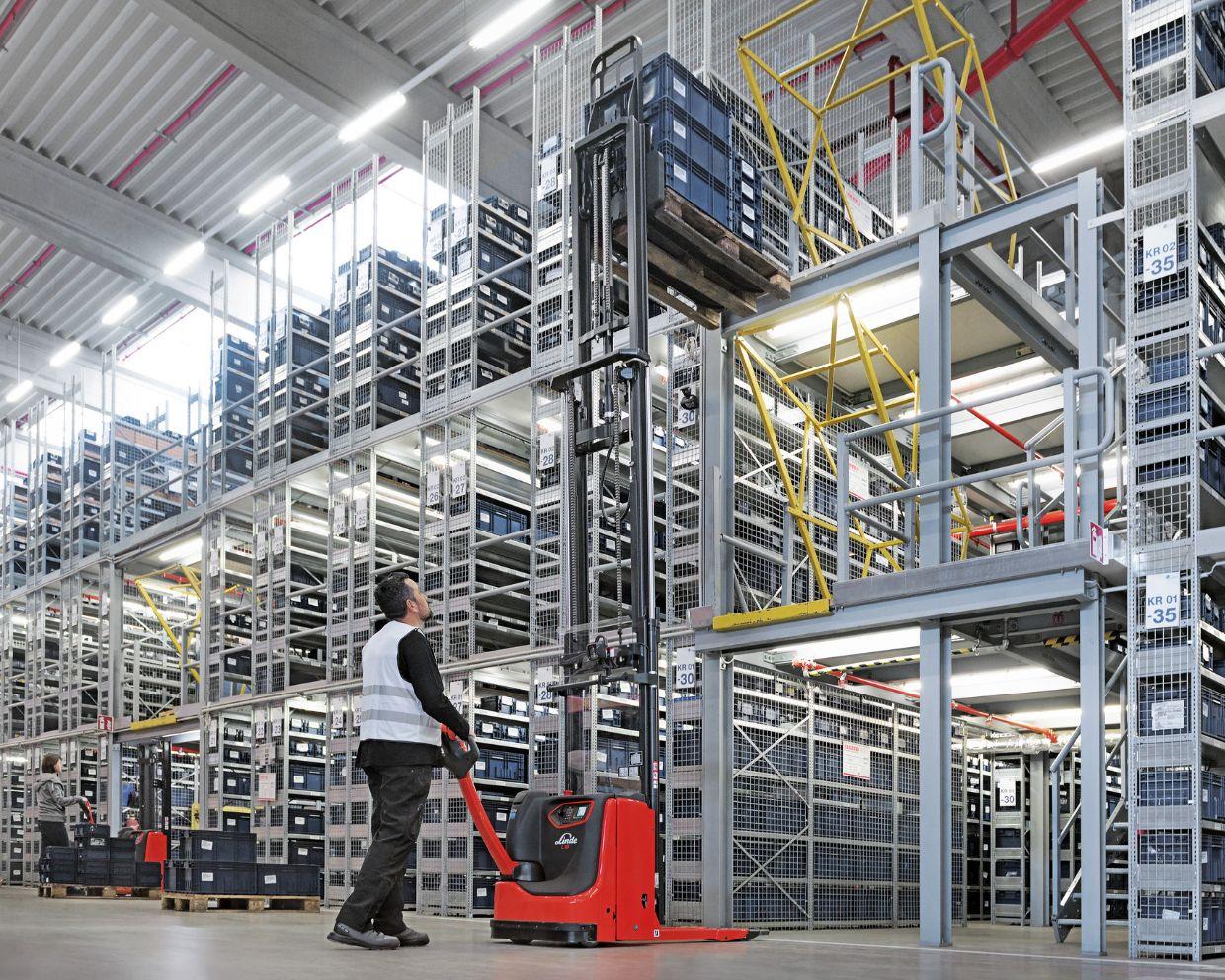
The walkie stacker has become one of the most practical pieces of equipment in modern Australian warehouse operations. Where counterbalanced forklifts are too large and manual handling is too slow, the walkie stacker fills the gap — handling palletised loads with precision in environments that simply don't have room for anything bigger.
Warehousing in Australia has changed considerably over the past decade. Facilities are handling higher stock volumes with the same or smaller floor space, lead times are tighter, and the push to reduce labour-related injuries is ever present. Against that backdrop, the walkie stacker is seeing consistent growth in uptake across retail logistics, cold storage, manufacturing, and third-party logistics (3PL) operations.
At Linde Material Handling, we work with businesses across Australia that are under pressure to do more with less. Time and again, the walkie stacker proves itself as the piece of equipment that unlocks that kind of operational efficiency.
How Are Walkie Stackers Used in High-Density Storage and Small Warehouse Spaces?
“Walkie stacker" and "electric pallet stacker" are often used interchangeably in the industry, and in most cases they describe the same category of pedestrian-operated electric equipment. Where it matters is lift height. Entry-level units built mainly for ground-level staging typically top out around 1.5 to 2.5 metres, which is fine for loading docks but not for reaching standard racking. Walkie reach stackers and straddle stackers, which is what most people mean when they talk about a walkie stacker for racking work, are built to go further, with lift heights of 4.5 metres and beyond on higher-spec models. That extra reach is what makes them a genuinely practical tool for vertical storage*.
That reach capability is what makes walkie stackers the preferred option in high-density storage environments, where maximising vertical space is not optional, it is the whole strategy.
In compact warehouses, retail backrooms, and distribution hubs, walkie stackers operate where a sit-down counterbalanced forklift simply cannot go. Aisle widths that would rule out a conventional forklift are navigable with a walkie stacker. Specific applications include:
- Narrow aisle racking: Walkie reach stackers can operate in aisles as tight as 2.5 to 3 metres, freeing up floor space for more racking rows
- Retail store backrooms: Where stock arrives on pallets but storage areas are small and ceiling height is limited
- Mezzanine operations: Some models are suited to mezzanine-level work where a full-size forklift is out of the question
- Distribution hubs: Cross-docking and staging areas where quick pallet movements in tight spaces are a daily reality
- Cold storage facilities: Where space efficiency is critical because every square metre of refrigerated space has a cost attached
The ability to work in constrained spaces without sacrificing lift height is the core reason so many Australian operations choose walkie stackers as their primary or supplementary lifting solution.
What Operational Benefits Do Walkie Stackers Provide in Daily Warehouse Workflows?
The day-to-day benefits of a walkie stacker comes down to three things: speed, safety, and less physical strain on operators.
Productivity in Loading and Unloading
Walkie stackers move quickly between tasks. An operator can receive a pallet from a delivery, transport it through the warehouse, and place it in racking without waiting for a licensed forklift driver or a larger machine to become available. That responsiveness matters in operations where throughput is measured by the hour.
In loading dock environments, walkie stackers are commonly used to pull pallets from delivery vehicles and stage them for putaway. The compact footprint allows operators to work alongside other equipment without creating bottlenecks, and most modern electric walkie stackers have sufficient battery capacity to sustain full shifts without interruption.
Reduced Manual Handling
Manual handling injuries are one of the most costly issues in Australian warehousing. Safe Work Australia data consistently identifies manual tasks as a leading cause of serious workplace injuries. Walkie stackers directly reduce the physical demand on operators by removing the need to manually lift, push, or reposition heavy palletised loads. That reduction in physical strain has practical benefits:
- Fewer lost-time injuries
- Lower workers' compensation costs over time
- Operators can sustain productivity for longer during a shift
- Easier compliance with manual handling risk assessments
Better Space Utilisation
Because walkie stackers can work in narrow aisles and reach standard racking heights, warehouses can store more in the same footprint. Operations that previously left vertical racking positions unused because they lacked the right equipment have often found that a walkie stacker unlocks storage capacity they already paid for.
Where Do Walkie Stackers Deliver the Most Value in Modern Supply Chains?
Across Australia's supply chain, there are specific environments where walkie stackers consistently outperform other options. When businesses search for a pallet stacker for sale, they are often responding to a very specific problem, usually a mix of space constraints, budget limits, and the impracticality of using a larger forklift for smaller-scale lifting tasks.
Retail Logistics
Retail distribution centres and store backrooms deal with high product turnover and limited storage space. Walkie stackers handle the constant cycle of receiving, storing, and picking stock without requiring forklift licences for all operators. For multi-site retail businesses, standardising on walkie stackers across locations also simplifies training and fleet management.
Manufacturing Floors
Manufacturing environments often have tight spaces around production lines where raw materials and finished goods need to be moved frequently. A walkie stacker can service these areas without disrupting workflow or requiring wide clearance aisles. They are particularly useful in facilities where stock needs to be staged close to production equipment.
Cold Storage Facilities
Cold rooms and freezer storage represent one of the most demanding environments for any material handling equipment. Space is expensive in temperature-controlled storage, so maximising racking density is a priority. Walkie stackers handle low-temperature environments well, and because they operate on electric power, there are no combustion emissions to manage in enclosed cold storage spaces.
Why Businesses Choose Walkie Stackers Over Larger Forklifts
The choice is often not about capability, it’s about fit. A sit-down counterbalanced forklift is powerful, but it needs wide aisles, a licensed operator, and significant floor space to manoeuvre. For businesses running smaller operations or managing areas within a larger facility, the walkie stacker is the right tool because it:
- Requires less floor space to operate
- Does not always require a full forklift licence (depending on the model)
- Costs significantly less to purchase and run than a full-size forklift
- Can be used in areas where a forklift would create safety risks for pedestrians
How Do Walkie Stackers Compare in Cost Efficiency and Equipment Investment Decisions?
When Australian businesses decide to buy a pallet stacker, one of the first questions is about cost. New walkie reach stackers in Australia range from around $12,000 for a basic moving mast model to $35,000 for a fully specified pantograph unit with lithium-ion battery and power steering. That is a meaningful investment, but it is also a fraction of what a sit-down counterbalanced forklift costs.
The Total Cost of Ownership Picture
Purchase price is only part of the equation. Over the life of the equipment, the costs that matter are:
- Energy costs: Electric walkie stackers run on significantly less energy than LPG or diesel forklifts. Charging costs are low and predictable.
- Maintenance: Electric equipment has fewer moving parts than internal combustion alternatives. That typically means lower service frequency and lower parts costs over time.
- Operator costs: Walkie stackers can often be operated by trained warehouse staff without the full licensing requirements that apply to sit-down forklifts, reducing wage premiums in some operations.
Rent-to-Own and Short-Term Options
For businesses that are not ready to commit to an outright purchase, hire-to-own arrangements at around $140 to $250 per week are available from many suppliers. This structure suits seasonal operations or new warehouse setups where throughput volumes are still being established. Rental also makes sense for short-term projects, but for ongoing operations, ownership nearly always delivers a better return.
Why Are Electric Walkie Stackers Becoming Essential in Modern Warehousing Operations?
The shift toward electric material handling equipment in Australia is not a trend, it is a direction that warehouse operators are actively choosing based on practical outcomes, not just sustainability messaging.
Zero Emissions in Enclosed Spaces
This is the most immediate reason for the switch in indoor environments. LPG and diesel forklifts produce exhaust emissions that needs to be managed with ventilation systems in enclosed warehouses and cold storage. Electric walkie stackers produce no direct emissions, which removes that requirement entirely. In food-grade facilities and cold storage, this is often a compliance issue, not just a preference.
Energy Efficiency and Running Costs
Modern lithium-ion battery technology has changed what electric warehouse equipment can do. Lithium-ion batteries charge faster, last longer between charges, support opportunity charging during breaks, and maintain consistent performance across the full discharge cycle. Operators are not dealing with performance degradation at the end of a shift the way older lead-acid battery equipment could exhibit.
Suitability for Continuous Operations
Electric walkie stackers are quiet, which matters in facilities that operate across multiple shifts or in environments adjacent to offices and customer-facing areas. They also produce less vibration than combustion alternatives, which has a long-term impact on operator comfort and equipment longevity.
The broader shift in Australian warehousing is toward cleaner, more efficient operations. Electric walkie stackers fit that direction and typically deliver lower total running costs over the equipment's life compared to combustion alternatives.
Why Choose Linde Walkie Stackers for Reliable Warehouse Performance?
At Linde Material Handling, we have been building material handling equipment for more than 100 years. That engineering experience shows up in our walkie stacker range in ways that matter in real warehouse conditions.
Built for Demanding Environments
Our walkie stackers are designed to handle demanding operational conditions, not just comfortable warehouse environments, but cold storage, manufacturing floors, and high-throughput distribution centres where equipment runs hard across multiple shifts. The build quality in Linde equipment reflects the kind of durability that keeps operating costs predictable over the long term.
Consistent Performance
One of the frustrations we hear from warehouse managers is equipment that performs differently depending on the operator or the time of day. Linde walkie stackers are engineered for consistency with the same precise handling characteristics, whether the unit is in the first hour of a shift or the last. That reliability reduces operator fatigue and helps maintain throughput rates.
Service and Support Across Australia
Linde Material Handling has branches and an extensive dealer network across Australia. When equipment needs service, that coverage means less waiting time and faster resolution. We offer genuine parts, trained technicians, and service agreements designed around keeping your operations running without extended downtime.
The combination of build quality, performance consistency, and local service support is why businesses across Australia choose Linde when they are investing in walkie stackers for the long term.
Upgrade Your Warehouse Efficiency with Linde Walkie Stackers
If your warehouse is dealing with space constraints, throughput pressure, or ageing equipment that is costing more to maintain than it should, a Linde walkie stacker is worth a serious look. Our range covers the full spectrum of walkie stacker applications from compact moving mast models for entry-level vertical stacking, through to high-specification reach stackers for demanding high-density storage environments.
Buy Linde walkie stackers today and optimise your warehouse operations with reliable, high-performance equipment. Explore our full walkie stacker range or contact your nearest Linde branch to talk through the right solution for your operation.
FAQs
What is a walkie stacker used for in warehouses?
A walkie stacker is used to lift, transport, and place palletised loads in racking or storage positions within a warehouse. Unlike an electric pallet truck, which only raises loads a short distance off the ground, a walkie stacker can lift to standard racking heights, typically between 3.0 and 5.5 metres depending on the model. They are used for receiving, putaway, picking, and general pallet movement in spaces where a sit-down forklift would be too large to operate safely.
Are electric pallet stackers suitable for heavy-duty warehouse use?
Electric walkie stackers are well-suited to regular warehouse use, with most models handling load capacities between 1,000 kg and 2,000 kg. For heavy-duty, high-frequency applications in large distribution centres, a ride-on reach truck or sit-down counterbalanced forklift may be more appropriate. That said, for operations with moderate throughput requirements and space constraints, a quality electric walkie stacker handles daily demands reliably. The key is matching the specification to the actual task: lift height, load weight, and operational hours all factor into the right choice.
What industries commonly use walkie stackers?
Walkie stackers are used across a wide range of Australian industries. The most common applications include retail logistics and distribution, food and beverage warehousing, cold storage and temperature-controlled facilities, light manufacturing and production support, pharmaceutical storage, and third-party logistics (3PL) operations. Any industry that handles palletised goods in a space-constrained environment is a likely candidate for walkie stacker use.
Is it better to buy a pallet stacker or rent one for short-term use?
For short-term projects or seasonal peaks, renting makes sense. Hire-to-own arrangements can also work well for businesses in the early stages of scaling warehouse operations. For ongoing warehouse operations with consistent throughput requirements, purchasing delivers better long-term value. The depreciation benefits available to eligible Australian businesses under current ATO rules, including the instant asset write-off threshold for small businesses, can also make outright purchase more financially attractive than it appears at first glance.
How do walkie stackers improve warehouse efficiency?
Walkie stackers improve efficiency in several ways. They allow faster pallet movement between receiving, storage, and dispatch areas compared to manual handling. They enable operations to use vertical racking space more fully, which increases storage density without expanding the warehouse footprint. They reduce the physical strain on operators, which supports consistent productivity across a full shift. And because they are electric, they require less maintenance than combustion equipment and produce no emissions that would require ventilation management. These factors reduce operational costs and increase the volume of work that can be done per shift.
To see our range of pallet stackers, click on the link below.
*Lift height range for entry-level electric pallet stackers sourced from IndustrySearch Australia, "Walkie Stackers vs Electric Pallet Stackers: Which Warehouse Lifting Equipment Is Better?" Always confirm exact lift height and capacity specifications against the individual model, as ranges vary by manufacturer and mast type.