Maintaining your forklift battery isn’t just a task on the checklist. In the world of warehouse logistics, the battery is the power source of your electric fleet. For businesses running a high‑demand environment in Australia, getting the maintenance, watering and care of your lead‑acid battery right can be a major factor in uptime, costs and safety.
Neglecting battery maintenance can lead to shorter battery life, unexpected downtime and higher replacement costs. This article covers how to water your forklift battery, sets out a proper maintenance schedule and provides key safety tips to keep your operation running at peak performance.
Why Do Lead-Acid Forklift Batteries Need Water?
For the typical lead‑acid battery used in many industrial trucks, proper water levels are key to ensuring a long lifespan and reliable performance.
The chemistry behind it
In lead‑acid batteries the electrolyte (sulphuric acid mixed with water) immerses the active plates. If the water content falls too low:
- The active paste can dry out and crumble.
- Plates become exposed to air, increasing sulphation and internal resistance.
- Risk of short circuits increases because plates can come into contact with the battery cover or with each other.
Risks of improper water levels
- Exposed plates can overheat, warp or short out, reducing capacity or failing altogether.
- Sediment can build up and impede performance, leading to more frequent recharging and reduced runtime.
Benefits of correct water levels
- Longer battery life: Regular maintenance helps you hit the expected lifecycle of a correctly maintained lead‑acid battery, typically around 1,000‑1,500 cycles.
- Reliable performance and capacity: A well-maintained battery supplies steady power with minimal energy loss throughout the shift.
- Reduced downtime and maintenance costs: Fewer failures, fewer battery swaps and less disruption for your operation.
When Should a Forklift Battery Be Watered?
First of all, we need to know when the battery should be watered. Some visible clues include:
- Each cell’s sight-glass showing electrolyte level below the top of the plate
- Build-up of white crusting (corrosion) around vent caps
- The tray area around the battery showing dried acid and sediment
These are indicators the battery water level has been neglected. Timing is everything when it comes to watering a forklift battery.
- Ideally you water after the battery has received a full or equalisation charge. Watering before or during charging can cause acid boiling and overflow.
- Watering when the battery is partially charged or hot may cause electrolytes to escape and expose plates.
- The frequency of water‑level checks depends on usage and ambient temperature:
- For heavy duty or multi‑shift use, check more often
- In Australia, where ambient temperatures in many regions are high and forklift trucks may run continuously, more frequent checks are warranted
- As a guideline, daily visual checks with a deeper check weekly or shift‑by‑shift if required by your operation.
Remember that in continuous operations (e.g., refrigerated warehouse or high ambient heat) water loss is more significant through evaporation or gassing, so your schedule needs to reflect that.
What Type of Water Should Be Used for Forklift Batteries?
The wrong water type can undermine all your good maintenance work.
Distilled water vs tap water vs de‑ionised water
- Distilled water is acceptable when de-ionised water is not available, provided it meets the correct purity standards and is used properly.
- Tap water may contain minerals and dissolved solids which can deposit on plates and internal surfaces. This leads to increased self‑discharge, reduced capacity and corrosion.
- De‑ionised (or demineralised) water is preferred because it contains significantly fewer dissolved ions and prevents mineral buildup. Using approved water types ensures optimal battery health.
Why tap water is a risk
- Mineral deposits reduce surface area of plates and interfere with chemical reactions.
- Corrosion increases internal resistance, heat generation and shortens battery life.
Benefits of de‑ionised water
- Prevents mineral buildup on plates and separators.
- Improves battery performance and longevity by maintaining clean electrochemical surfaces.
- Reduces corrosion, internal resistance and self‑discharge rates.
How Can You Water a Forklift Battery Safely and Accurately?
Maintaining your battery water levels safely and accurately protects both your people and equipment.
Manual filling (traditional method)
- Historically each cell had to be topped up individually with a watering jug or hose.
- Limitations: Variation between operators, inconsistent levels, risk of overfilling or spills.
Single‑Point Watering (SPW) systems
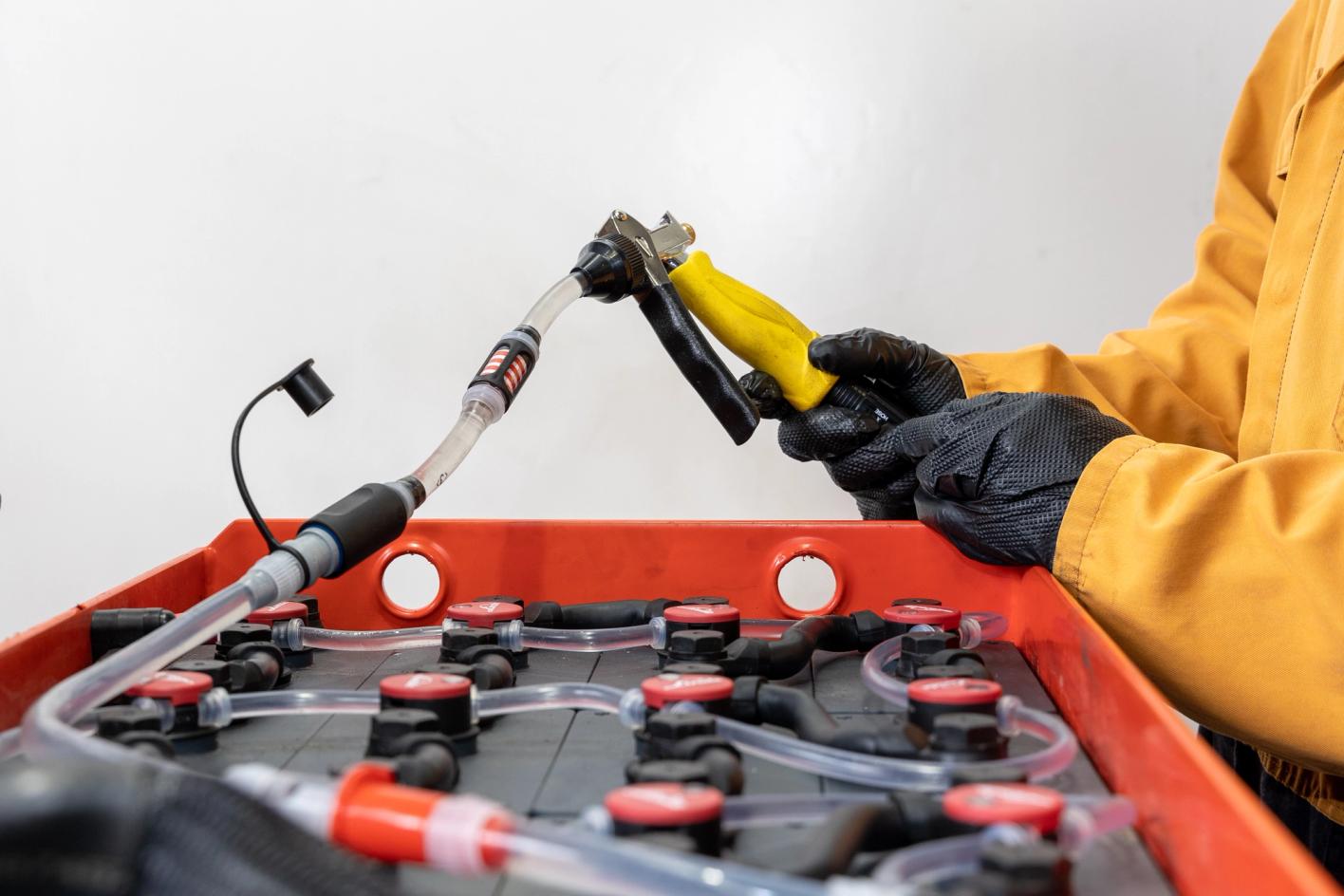
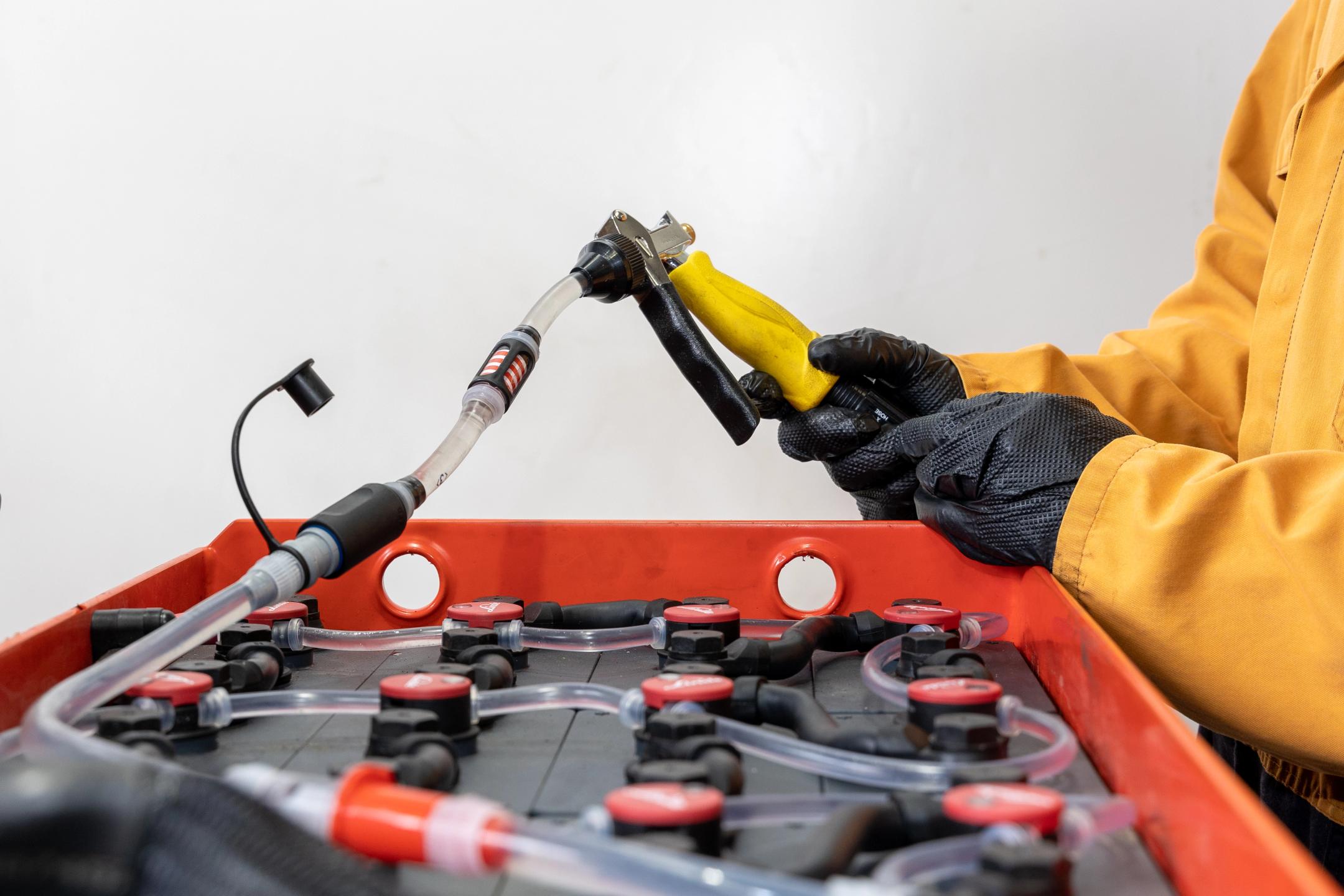
Modern operations increasingly use SPW systems for precision and safety. Monitoring systems and LED indicators alert operators when water is required or the system is active. These may include:
- Gravity feed systems: A gravity tank positioned above battery height feeds water through interconnected float valves, automatically stopping when each cell reaches the correct level.
- Manual gun with garden hose: A regulated watering gun ensures each cell fills to the correct level.
- Automatic water solenoid triggered by charger: The watering system is integrated with the charging cycle so that once the battery has completed its charge, a solenoid valve activates and dispenses the correct amount of water.
Safety tips for operators
- Always wear acid‑resistant gloves and goggles when working with lead‑acid batteries and electrolytes.
- Ensure trained personnel carry out battery watering. Incorrect practices carry risk of acid burns, spills and damaged equipment.
- Adequate ventilation around the battery charging and watering area is important (gassing occurs during charging).
- Use signage and protocols for battery maintenance zones in your warehouse.
How Should Forklift Batteries Be Maintained Beyond Watering?
Watering is just one piece of the maintenance puzzle. A holistic maintenance regime will extend battery life and improve forklift uptime. Linde Australia’s nationwide network can offer help with both equipment and battery maintenance.
Daily visual inspections
- Check electrolyte levels (via sight glasses or cell caps) for low level or exposed plates.
- Inspect for corrosion on terminals, battery tray or connections.
- Look for leaks or damage to the battery casing or clamps.
Regular cleaning and terminal maintenance
- Clean battery top surfaces and terminal posts monthly to prevent corrosion buildup.
- Ensure tray and mounting are secure and free of debris or acid residue.
Correct charging procedures and schedules
- Match charger to battery type and capacity.
- Avoid overcharging or deep discharging cycles; both shorten lead‑acid battery life.
- Some operations still use equalisation charges (a controlled overcharge) to balance cells.
- For multi‑shift or continuous operations consider upgrading your energy solutions to faster charging options like lithium‑ION batteries.
Keeping service logs to maintain warranty compliance
- Document watering, charging, inspections and servicing.
- Many manufacturers or suppliers, including Linde Material Handling Australia, require maintenance records to validate warranty claims.
- Good records also help track trends. Increasing water loss, frequent recharges or capacity drop can signal battery ageing.
What Common Mistakes Should You Avoid When Watering Forklift Batteries?
Avoiding mistakes is as important as doing the maintenance correctly.
- Overfilling or underfilling cells: Both can harm battery life and performance. Overfilling before charging can cause electrolyte expansion and boil-over during the charge cycle. This shows up as either bubbles escaping the batter, or as wet acid residue around the cell vents.
- Using unapproved water sources: For example, untreated tap water, which deposits minerals.
- Watering before charging or during an active charge cycle: This increases risk of electrolyte expansion, boil‑over and spills.
- Skipping maintenance schedules: The “set and forget” mentality is risky for lead‑acid systems.
- Allowing untrained staff to handle battery maintenance: Increases safety risks.
How Can Modern Watering Systems Improve Battery Maintenance?
Upgrading from manual methods to modern watering systems can deliver big returns.
Time‑saving benefits of SPW systems
- Rapid fill times versus manual topping‑up of each cell
- Reduced operator time and human error
Accuracy and consistency in water levels
- All cells are filled to the same correct level, supporting electrolyte balance and extending battery life
- Lower risk of uneven electrolyte levels between cells
Reduced risk of operator error
- Automated systems reduce reliance on technique and ensure consistency across shifts and operators
ROI and productivity benefits of automated systems
- Reduced risk of premature battery issues caused by improper watering
- Extended battery life means lower replacement cost over the fleet lifetime
- Improved uptime for your forklifts = better productivity in your warehouse or logistics centre
What Are the Real‑World Benefits of Proper Battery Maintenance and Watering?
When maintenance is done properly, the benefits go beyond “less downtime”.
- Reduced downtime and extended battery life: A well‑maintained lead‑acid battery can reach its expected cycle life of around 1,000‑1,500 cycles.
- Cost savings on replacements and repairs: Fewer failures mean fewer emergency replacements and less strain on budgets.
- Improved forklift productivity: With reliable battery output, trucks meet shift targets without slowing down operations.
- Safety improvements in Australian warehouses: Proper water levels, correct charging and clean maintenance reduce risks of acid spills, overheating, and battery failures, especially important under Australian operational conditions (heat, long hours, continuous use etc.).
How Proper Battery Maintenance Protects Your Investment
Proper battery maintenance for your forklift fleet centres on four key pillars: selecting the right water type, watering at the right time, using safe and accurate systems, and maintaining a full maintenance regime beyond watering.
- Use de‑ionised water, not untreated tap water.
- Water after a full or equalisation charge, not during active charging.
- Keep doing visual checks, cleaning, charging discipline and service logs.
- Avoid common mistakes like overfilling, under‑filling, allowing untrained staff to water batteries or skipping schedules.
Get in touch with Linde Australia today for expert training and battery maintenance support to keep your fleet powered with reliability and efficiency.