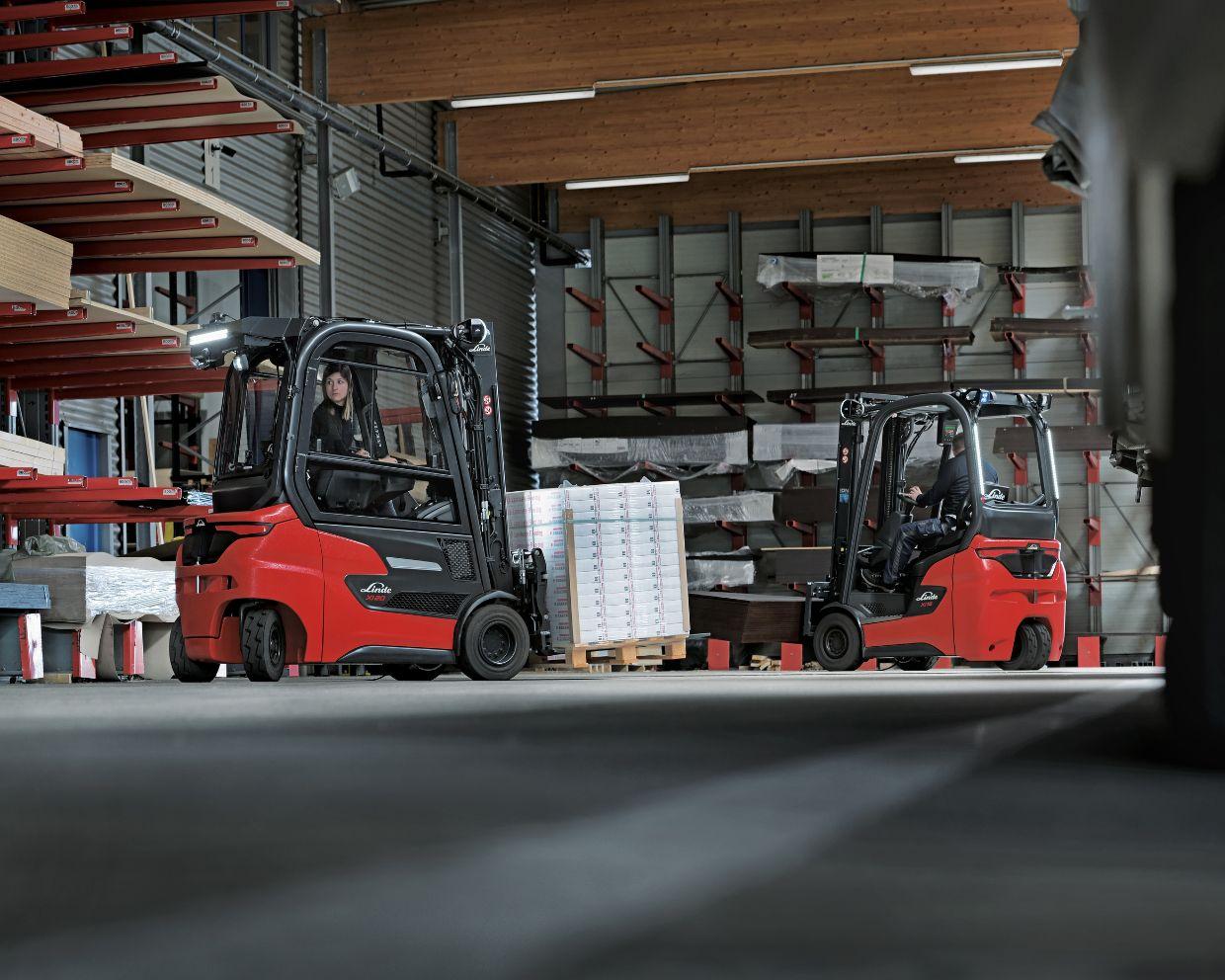
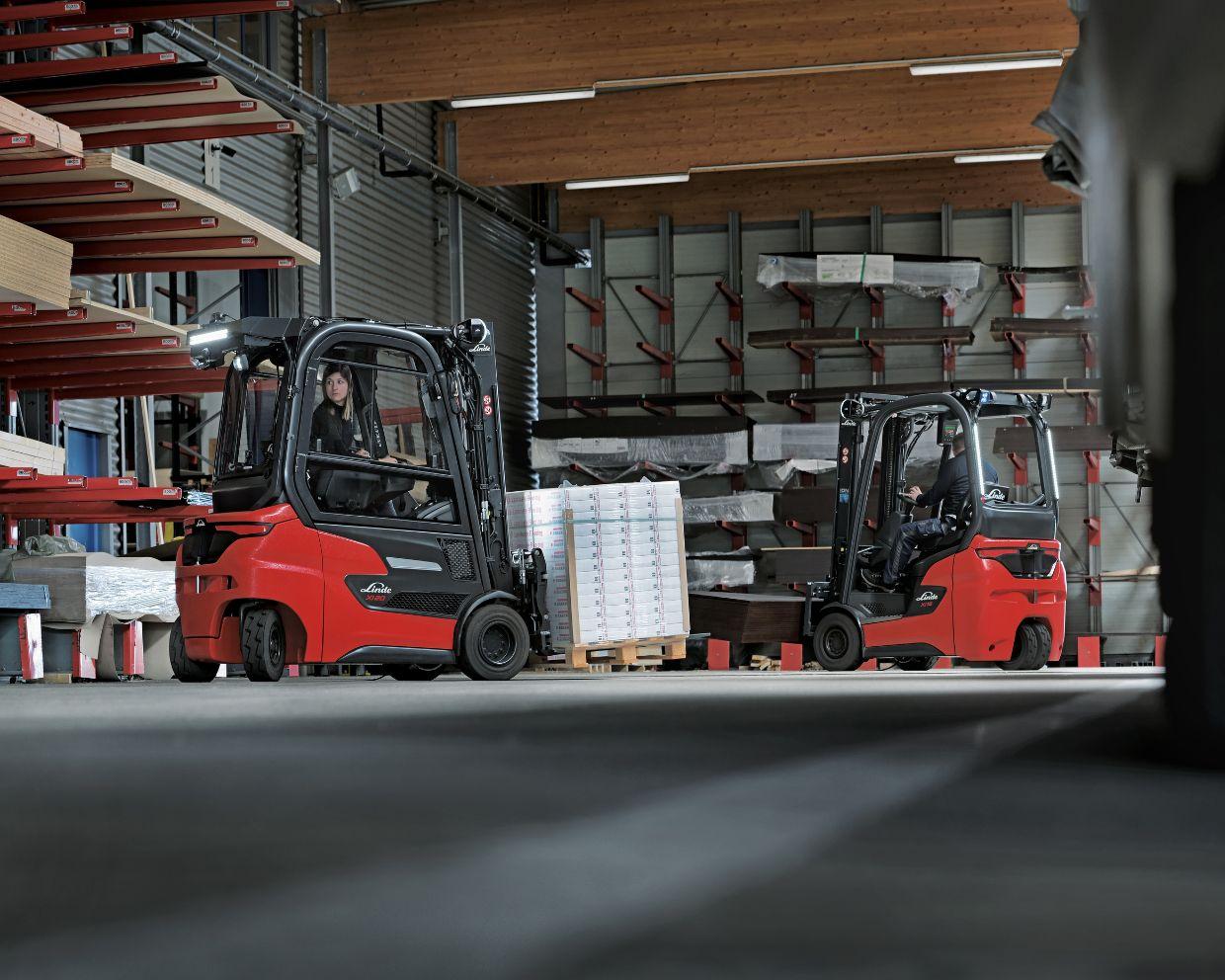
When it comes to comparing a 3-wheel vs 4-wheel forklift, it’s more than a matter of preference. The right forklift type impacts your facility’s safety, efficiency and productivity. Selecting the appropriate design ensures you match the forklift to your warehouse layout, load requirements and working environment. This forklift buying guide will help you make an informed decision.
What Are the Key Differences Between 3-Wheel and 4-Wheel Forklifts?
When comparing 3-wheel and 4-wheel forklifts, several core differences influence their performance, suitability and operational context:
- Manoeuvrability & Turning Radius
- 3-wheel forklifts use a single rear wheel, which gives them a much smaller turning radius. This makes them ideal for tight spaces and narrow aisles.
- 4-wheel forklifts, by contrast, generally have a larger turning circle. While they may still offer rear-wheel steering, the added wheelbase can limit sharp turns in tight corridors.
- Stability and Load Handling
- 3-wheel models excel on smooth, level surfaces with lighter or moderate loads and are common in warehousing and indoor distribution facilities.
- 4-wheel forklifts typically provide greater stability thanks to their broader wheelbase and evenly distributed support. This makes them better suited to heavier loads, mixed indoor/outdoor operations, or environments with varying floor surfaces.
- Operational Environments
- 3-wheel forklifts work best indoors in high-density storage facilities with narrow aisles and smooth concrete floors.
- 4-wheel forklifts are more versatile, they can be used in small warehouses, larger distribution centres, mixed indoor/outdoor yards, and operations requiring heavier lifting.
In the context of Linde for example, the E14–E20 range offers a three-wheeled electric counterbalance option, optimised for compact indoor spaces. Meanwhile, Linde’s 4-wheel electric forklifts, such as those in the E16–E20 series, embody the sturdiness, power and comfort expected in heavier or more versatile operations.
How Do You Decide Which Forklift Is Right for Your Warehouse?
The choice between 3-wheel and 4-wheel forklifts depends on several practical factors. Here’s a decision framework to help you choose the right option for your facility:
- Warehouse Size & Aisle Width
- If your warehouse has narrow aisles, tight corners, or high-density shelving, a 3-wheel forklift is often the better choice. Its compact chassis and tight turning radius maximise space usage.
- If aisles are wide and there’s room to manoeuvre or if you expect to use it in both the warehouse and outside yard, a 4-wheel forklift may offer greater flexibility.
- Load Types and Weights
- For lighter loads (e.g. under ~2 tonnes) and general pallet handling, a 3-wheel forklift is efficient and cost-effective.
- For heavier, bulkier or irregular loads, or frequent stacking/unstacking at higher shelves, a 4-wheel model provides stability and load-bearing capability.
- Operational Needs & Frequency of Use
- If your operations involve frequent, rapid pallet movement in confined indoor spaces (e.g. retail warehouses, order picking, tight racking), the agile 3-wheel forklift will enhance throughput and reduce manoeuvring time.
- For operations requiring regular outdoor movement, mixed-floor surfaces, heavier loads or long shifts, 4-wheel forklifts give you robustness and versatility over time.
- Energy Type, Maintenance, and Total Cost of Ownership
- If you aim for lower maintenance and quieter operation, especially relevant in indoor environments, electric 3-wheel forklifts offer clear advantages.
- For heavier workloads or outdoor/rough surface tasks, a 4-wheel forklift, possibly with internal combustion or robust electric drive, may offset the higher maintenance or energy use with reliability and flexibility.
Using this framework, you can align your warehouse’s layout, load profile and operational rhythm to the forklift type that yields the best performance and cost efficiency over time.
What Are the Safety Considerations for 3-Wheel vs 4-Wheel Forklifts?
Safety is paramount in any material-handling operation. When comparing 3-wheel and 4-wheel forklifts consider these factors:
- Stability on Various Surfaces
- 3-wheel forklifts are best suited to smooth, level indoor floors. On uneven terrain, ramps or rough surfaces, their single rear wheel design may compromise stability, especially under load.
- 4-wheel forklifts offer greater stability across diverse surfaces, including slightly uneven floors and outdoor yards, reducing the risk of tipping or instability during lifting.
- Turning and Load Handling Safety
- For 3-wheel models, precise control is essential when cornering or navigating narrow aisles. Overloaded or fast turns can increase tipping risk. Limiting operation to smooth, flat surfaces is advisable.
- 4-wheel forklifts handle heavy loads and lifting at height with greater stability, supported by their broader wheelbase and load distribution.
How Does Efficiency Differ Between 3-Wheel and 4-Wheel Forklifts?
Efficiency is about more than just speed. It’s also about how effectively a forklift matches your space, load profile and workflow. Here’s how 3-wheel and 4-wheel forklifts compare in typical warehouse scenarios:
- Speed & Manoeuvring in Tight Spaces
- In narrow-aisle warehouses or dense racking systems, a 3-wheel forklift can move with minimal turning, reducing travel time between picks, loading/unloading or pallet movement. This agility can increase throughput and reduce operator fatigue.
- For high-density indoor distribution centres, the compact size of a 3-wheel forklift maximises usable storage space by allowing narrower aisles, which in turn increases storage capacity per square metre.
- Productivity with Heavy Loads and Mixed Operations
- When operations include heavier or bulkier pallets, frequent stacking/unstacking at height, or mixed indoor/outdoor tasks, a 4-wheel forklift can sustain productivity. Its stability and load-handling capability reduce downtime related to careful load manoeuvres or repositioning.
- In yards, on loading docks, or when transitioning between warehouse and outdoor storage, 4-wheel forklifts deliver consistent performance, reducing delays caused by unsuited equipment.
- Operator Comfort and Long-Term Use
- Linde’s electric forklifts, both 3- and 4-wheel, prioritise ergonomics with sealed compact axles, dual-pedal control, fingertip joysticks, and vibration-damped cabins improving comfort and reducing fatigue over long shifts.
- Less operator fatigue translates to fewer errors, better concentration, and ultimately higher throughput over time.
Thus, efficiency gains differ by application where 3-wheel forklifts drive efficiency in high-density indoor environments and 4-wheel forklifts excel in more varied, heavier-duty or mixed-space operations.
What Features Should You Look for When Buying a Forklift?
When investing in a forklift, whether 3- or 4-wheel, these are the essential features to evaluate:
- Load Capacity & Lift Height: Ensure the forklift matches your maximum load weight and required stacking/racking height. Linde’s electric forklifts come in different load capacities, making it easier to align the truck with your operational needs.
- Ergonomics and Operator Comfort: Look for adjustable seats, intuitive controls (joystick or mini-wheel steering), dual-pedal drive systems, and well-positioned controls that reduce operator strain and fatigue. Linde models employ ergonomic cab design, cushioned armrests, adjustable steering columns and user-friendly controls.
- Energy Type & Efficiency: Electric forklifts offer benefits in indoor and multi-shift use with zero emissions, quieter operation, lower maintenance, and often lower operating costs over time. Linde electric ranges, for instance, feature maintenance-free compact drive axles and efficient battery systems, including compatibility with lead-acid, lithium-ION or even fuel-cell batteries.
- Maintenance & Serviceability: Sealed drive axles, minimal wear components, easy access to service points, and long maintenance intervals contribute to high uptime and cost-effective ownership. Linde’s electric trucks are designed with these considerations in mind.
- Advanced Safety Systems & Visibility: Features to prioritise include low centre of gravity, stable mast construction, good all-round visibility, tilt safety, and optional assistance systems (e.g. load-sensing, speed control, reverse-assist radar or camera).
How Can a Forklift Buying Guide Help You Make the Best Choice?
Using a structured forklift buying guide, such as this one, ensures you assess all critical factors including warehouse layout, load profiles, operational patterns, safety requirements, energy use and maintenance over time. This process helps avoid costly mismatches between equipment and operation, which can lead to accidents, inefficiency or early wear.
At Linde, our expertise lies in matching the right forklift model to your application. We can help you select a forklift that balances safety, productivity and total cost of ownership, whether that’s a nimble 3-wheeled electric model for narrow aisles or a sturdy 4-wheeled machine for heavier-duty tasks.
Choosing the right forklift isn’t just about wheels. It’s about aligning your operations with the right equipment. Use this forklift buying guide to make an informed decision, and partner with Linde to ensure a safe, efficient and future-ready material-handling solution.
Click on the link below to check out Linde’s extensive forklift range.