
THE EARLY YEARS
1904 – 1954

The roots of Linde Material Handling dates back to the beginning of the 20th century. Together with Hugo Güldner and Georg von Krauss, Carl von Linde founded Güldner-Motoren-Gesellschaft in Munich in 1904. Three years later the company moved to Aschaffenburg and then in 1929, Carl von Linde’s company took over. In its early days, Linde made its name in oil, diesel and refrigeration but in 1955 this all changed. 1955 – 1970 In 1955 the Hydrocar was introduced. This was the first transport vehicle with Linde's patented hydrostatic drive, which provided seamless acceleration, both forwards and backwards, with full engine power and without the need for a transmission. This technological innovation created efficiencies that saved on fuel, reduced tyre wear and improved safety.

In 1959 the Hubtrac, ancestor of all Linde forklift trucks, was produced. It was the first forklift to include a hydrostatic transmission, revolutionising the industry.

Nine years later in 1968 the 314 replaced the Hubtrac and remained in production until 1980.

OVER 50 YEARS OF KEEPING AUSTRALIANS SAFE

In 1970 Australia was introduced to Linde’s innovative forklift technology. Linde started in Australia under the name Lansing Bagnall and was based in Lidcombe, NSW. In 1989 Linde AG acquired Lansing Bagnall and became Linde Lansing. In 2005, the business officially changed its trading name to Linde Material Handling and that is where we find ourselves today!
A HISTORY BUILT ON SAFETY
One of the key reasons our customers tell us that they’ve chosen Linde over a competitor is safety. From outstanding operator visibility to industry leading ergonomics and the inherent anti roll back assurance of our hydrostatic drive system — our commitment to safety is second to none. Linde safety solutions have been developed to ensure they address the specific safety requirements of individual businesses. This includes reducing risks to the operator, personnel, equipment and warehouse. See below for a list of just some of the innovative intelligent assistance systems we’ve launched over the years — there’s far too many to fit into one page! If you want to find out more about how Linde can help improve safety in your business, contact us for a free consultation.
FleetFOCUS
With Linde FleetFOCUS, you can review Workplace Health and Safety (WHS) compliance, cost efficiency and accountability via a web-based interface. This Australian built fleet management technology also enables engagement with Linde as a strategic partner, to help you assess important data in order to simplify and streamline your decision making.

Reverse Proximity Alarm An acoustic and visual warning that reduce accident potential in confined or obscured warehouse areas. It also automatically reduces the speed of the truck when an obstacle is detected, and can be programmed to respond to predetermined speed zones.

Linde Load Management Automatically calculates residual capacity based on the height of the forks and the weight they are carrying. Visual and audible warnings activate in safety-critical conditions, and speed reduction is applied in relation to the residual value, and as the steering angle increases.

Automatic travel speed control & Linde Curve Assist A speed assist system that provides automatic speed limitation, tailored to your business’ needs, throughout your site for both indoor and outdoor areas. A curve assist system that provides automatic, proportional speed adjustment when a truck is cornering, to create a safer working environment for the operator and nearby personnel.

Removal of the A-Pillar With an exciting new vehicle concept applied to our electric forklift trucks, we were able to introduce the Linde overhead tilt cylinders, which meant the A-pillar was no longer needed! This new design maximised the driver’s field of vision, thus improving safety.

Safety Pilot The system enables the operator to preselect their lift height, input lifting and lowering limits and have precise control at the touch of a button — helping to reduce operator error.

Dynamic Mast Control Automatically compensates and minimises mast oscillations and mast deflections through precise and seamless counter-movements of the reach carriage. This ensures smooth, simultaneous lift and reach movements for reach trucks.

BlueSpot A visual warning that projects a large, bright blue spot onto the floor several metres ahead of the vehicle in the direction of travel.

TruckSpot Building off the BlueSpot system, this projects a large 1.25 metre warning triangle several metres in front of a reversing forklift, providing an even more effective alert for nearby pedestrians and other forklift drivers.

Warning lines Clearly-visible bright lines are projected from the forklift onto the floor of the workspace around the truck, to clearly indicate hazardous areas for nearby pedestrians.

Stationary warning projector A compact, high performance LED spotlight that projects warning symbols from a fixed position, giving an visual warning to anyone in the path of an oncoming forklift.

LED stripes Lighting up white in the direction of travel and red in the opposite direction, they give the driver the best possible visibility and allow other vehicles/pedestrians to quickly and easily identify which direction the truck is travelling in.

VertiLight Illuminates a large working area thanks to its half-circular design with wide light band and seven LEDs. The LEDs distribute the light uniformly from the floor to the upper edge of the shelf, improving visibility of the shelf, load and forks. Thanks to the anti-glare LEDS, oncoming vehicles/pedestrians are less dazzled, and the driver is not irritated by reflective goods or truck interiors.

Linde Safety Guard Using transmitters on trucks, walls, racking and even carried on personnel themselves, the Linde Safety Guard systems creates warning zones to reduce the risk of accidents. If a pedestrian and a truck look likely to collide, both the industrial truck and the pedestrian are warned through a series of haptic, audio and visual signals. This system also works through walls or racking to alert workers coming around corners or through doors. Speed restriction zones can also be pre-defined and programmed so that the system automatically reduces the truck’s speed when in these zones. This is all made possible because the Linde Safety Guard system is able to detect marked objects or personnel with a position accuracy of ten centimetres, and warning zones are individually adjustable. This level of precision also minimises false alarms.

OUR GOAL: TO HELP OUR CUSTOMERS AVOID 100% OF ACCIDENTS IN INTRALOGISTICS
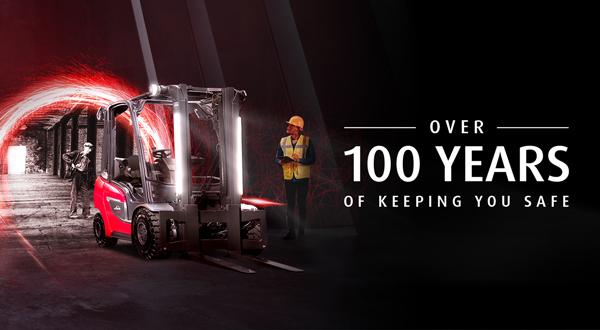
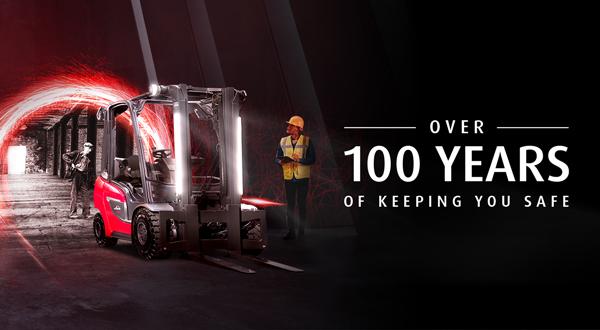
Linde’s ongoing dedication to developing intelligent safety technology, as well as technical innovations in our industrial trucks, provides integrated solutions that help our customers master the diverse challenges of modern, safe intralogistics. Thus, giving them the best outcomes for their business. We’ve kept you safe for over 100 years and we look forward to doing that for 100 more. If you want to find out more about how Linde can help improve safety in your business, contact us for a free consultation.