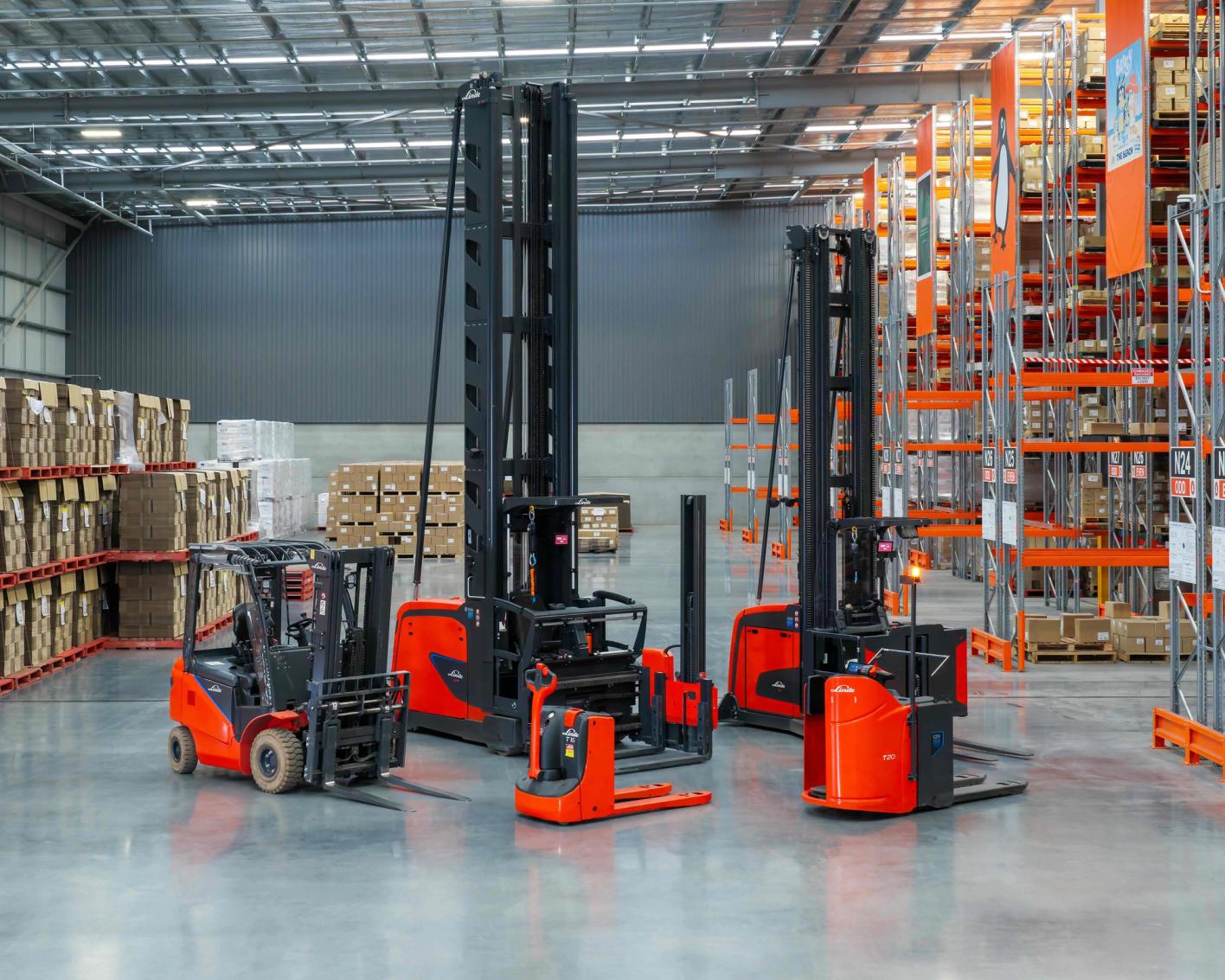
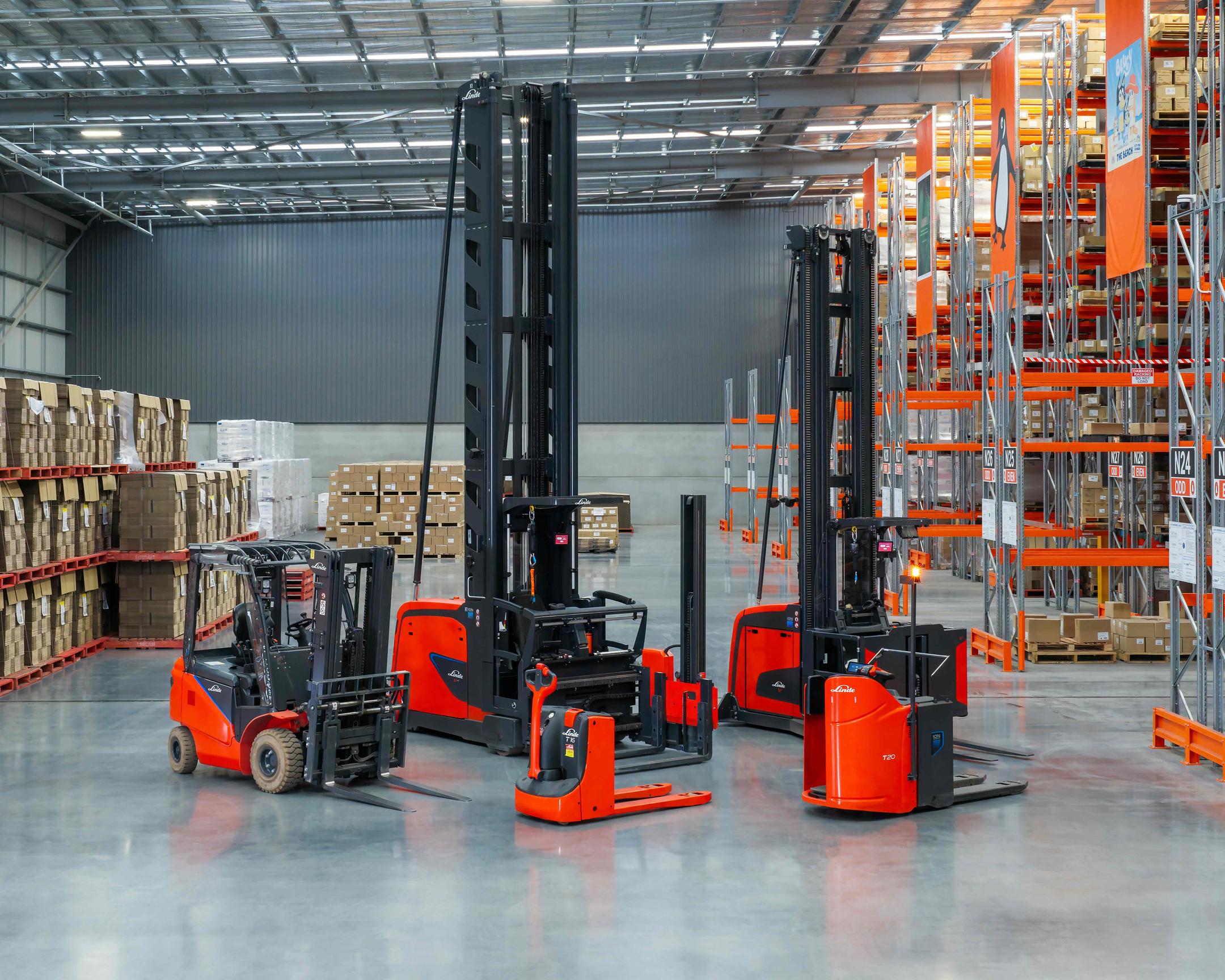
When Penguin Random House consolidated its Australian and New Zealand distribution operations into a new facility in Dandenong South, it needed a material handling solution capable of keeping pace with an operation of enormous scale and complexity. Linde Material Handling Australia worked closely with the publisher to engineer a fleet around its unique requirements – from very narrow aisles and high-level storage to lithium-ion power, advanced safety technology and fleet management.
As the largest publisher in the world, particularly in the English language, Penguin Random House’s distribution operation ships approximately 35 to 37 million books each year, along with book-related merchandise, to customers across the ANZ region.
Behind those numbers is a highly complex warehouse operation.
On an average day, between 6,000 and 8,000 cartons leave the Dandenong South facility, representing as many as 40,000 individual product lines or order picks. Approximately 200 to 300 pallets arrive each day, while another 2,000 to 3,000 cartons are replenished into picking areas.
Supporting that volume are 50,000 pallet locations, 57,000 long-span shelving locations, approximately 150 employees and a two-shift operation.
“Our partnership with Linde is one of our most important partnerships because we operate at scale. A significant amount of product comes in and out, and without the equipment to move product around the warehouse, prepare it and load it onto trucks, we couldn’t operate,” says Matt O’Brien, Operations Director at Penguin Random House.

A New Chapter in Dandenong South
Before moving to Dandenong South, Penguin Random House had outgrown its existing Scoresby operation.
At one point, the business was operating across four separate buildings, creating congestion and spreading employees and equipment across multiple locations. Bringing the operation back under one roof presented an opportunity to address those inefficiencies while supporting future growth.
The new facility, however, introduced its own material handling requirements.
Space was at a premium, resulting in very narrow aisles designed to maximise storage density. A pitched roof also allows racking heights to progressively increase towards the centre of the facility, reaching approximately 12.5 metres.
Penguin Random House required equipment capable of operating efficiently within narrow aisles, handling loads at significant height and adapting to varying lift limits throughout the warehouse.
Improving fleet utilisation was another key objective. Rather than simply replacing like-for-like, Penguin Random House went to market looking for what was possible.
Engineering the Right Solution
From the beginning of the tender process, the complexity of the application required more than an off-the-shelf solution.
“We wanted machines that suited our operation,” says Jim Rozanitis, Operations Manager at Penguin Random House. “Linde were constantly asking us questions – what’s your height, what are you trying to do, what are your cycles? Eventually the penny dropped. They were asking those questions because they wanted to provide a machine that was tailored to our site.”

Linde’s Technical Solutions team worked with detailed operational information including throughput, working patterns, aisle dimensions and expected equipment utilisation to engineer the trucks around the application and determine appropriate battery capacities.
“It wasn’t a case of quoting a standard machine and hoping it would fit. We needed to understand the operation in detail and build the trucks around what Penguin Random House actually needed,” says Dion De Pace, Senior Business Development Manager at Linde Material Handling Australia.
The resulting fleet includes Linde K-Series turret trucks, V-Series order pickers, E20 electric counterbalance forklifts and T20 ride-on pallet trucks.
The turret trucks are predominantly used to transfer incoming stock into high-level racking, while the order pickers support carton picking and replenishment. The E20 counterbalance forklifts handle vehicle loading and unloading, while pallet trucks move pallets throughout the facility.
Operator comfort was also an important consideration.
For the V-Series order pickers, the operator’s position provides clear visibility towards the load, while an auxiliary pallet lift allows the working height to be adjusted as the pallet is built. This reduces repeated bending and helps operators maintain a more comfortable working position throughout a shift.

The E20 forklifts also incorporate Linde’s dual-pedal system, enabling operators to change direction using the pedals without repeatedly moving between accelerator and direction controls.
The response from operators has been particularly positive.
“Our operators are on these machines for long periods, so comfort was crucial. The feedback when they first got onto them was exceptional – the stability, the comfort and the ergonomics really stood out,” says Jim.
With some equipment from Penguin Random House’s former fleet remaining on site during the transition, that preference has become especially visible.
As one team member put it, operators have been known to arrive around 10 minutes early simply to secure a Linde machine for their shift.
Writing Safety into the Operation
Safety was one of Penguin Random House’s highest priorities when selecting its new material handling provider, with the business identifying mobile plant as one of its most significant operational risk areas.
With employees working in and around very narrow aisles, and operators travelling at significant heights, Linde incorporated a range of systems designed to provide additional safeguards throughout the warehouse.
Wire guidance keeps the specialised equipment correctly positioned within the aisles, while RFID tags installed throughout the facility allow each machine to determine where it is operating and respond according to programmed parameters.
This is particularly important because of the building’s pitched roof. Depending on the truck’s position within an aisle, the equipment can automatically restrict its maximum lift height rather than relying solely on the operator to judge available clearance.
“It’s not up to the operator to limit the height of the machine. It knows where it is in the aisle and it limits itself,” says Dion.

Pedestrian detection technology provides another layer of protection. If a pedestrian enters the machine’s operating area, the system can respond by slowing or stopping the truck.
Reverse cameras, automatic speed reduction and stability at height add further layers of protection.
Together, these features allow Penguin Random House to manage safety within a demanding very-narrow-aisle operation while maintaining productivity.
More Uptime with Lithium-Ion
Energy was another major consideration. Penguin Random House’s previous fleet predominantly relied on lead-acid batteries, which required lengthy charging periods, battery changes and ongoing maintenance. In a two-shift operation, maintaining equipment availability could therefore require additional batteries or machines.
Linde’s analysis of the expected workload identified lithium-ion as a better fit.
Rather than taking machines out of service for extended charging periods, operators can opportunity charge during breaks throughout the day. This enables the fleet to continue through the second shift and, during peak periods, support a third shift.

“The opportunity charging was definitely one of the things that got our attention. Rather than having a machine parked for hours, we can charge throughout the day and keep it operating.” says Jim.
The benefits became particularly clear during Penguin Random House’s relocation to Dandenong South.
At the height of the transition, incoming pallet volumes increased significantly and Penguin Random House introduced a temporary third shift to manage the workload. The lithium-ion fleet continued operating throughout, reinforcing the decision to move away from lead-acid technology.
Delivering the Move
Engineering the solution was only one part of the project. Getting the fleet operational in time for Penguin Random House’s relocation required extensive coordination between both businesses.
The scale and dimensions of the specialised equipment meant some trucks could not simply arrive on site fully assembled. Linde instead coordinated delivery, assembly and commissioning in stages as the warehouse itself took shape.
The rollout was timed around Penguin Random House’s transition from Scoresby, with equipment made available as different areas of the new warehouse became operational.
The move itself involved transferring approximately 28,000 to 30,000 pallets between the two facilities, requiring an estimated 300 to 400 B-double movements.
Throughout the process, regular communication kept Penguin Random House informed as equipment moved through production, shipping and delivery.
“Linde would update me throughout the whole process – this is in production, this is on the boat, this is on its way,” says Jim.
“That was critical for us. It was very quick, very proactive and they were always willing to help us out in a tight situation.”
Greater Visibility Across the Fleet
Once the fleet was operational, Penguin Random House also implemented Linde’s telematics system FleetFOCUS across its equipment.
The system brings information including pre-start checks, utilisation and incident reporting into one platform, giving the warehouse team greater visibility over its fleet.
It also assists with identifying and following up on issues such as impacts and licence expiries while providing insight into how equipment is being utilised across the operation.
A Partnership Built for the Long Term
For Penguin Random House, the right material handling partner is about more than the equipment itself. In an operation moving millions of books each year, reliability and access to responsive service support are equally important.
“The fleet since we switched to Linde has been exceptionally reliable,” says Matt.

“We downsized the number of machines when we moved here, and that hasn’t been an impediment because the equipment is available and operating when we need it.”
The partnership now includes ongoing account management, fleet reviews and service support.
“Running an operation this busy, things do go wrong. What matters is knowing that when you pick up the phone, you’ll get the response you need,” says Jim.
“They understand our requirements and how critical this equipment is to the operation. Having that relationship has been really beneficial.”
For Linde, that collaboration remains central to the way the account is managed.
“I find the relationship between Linde and Penguin Random House very strong,” says Russel Day, Service Manager at Linde Material Handling. “If there’s something they need help with, they don’t hesitate to pick up the phone, and we work together to find a solution.”
Penguin Random House expects its material handling investment to support the operation for many years, making the relationship one that extends well beyond the initial fleet rollout.
As Matt puts it:
“Linde is critical to our success because material handling equipment is fundamental to our operation. Without it, we simply can’t deliver the outcomes our customers need.”
If you'd like to understand how Linde could boost the productivity of your operation, contact us today.